Maileva (La Poste) leak: 22 million addresses stolen, watch out for fake payment reminders
The names and addresses of 22 million people were stolen from Maileva, the La Poste subsidiary that sends letters for companies. Here is what leaked, and how to spot the fake reminders likely to follow.
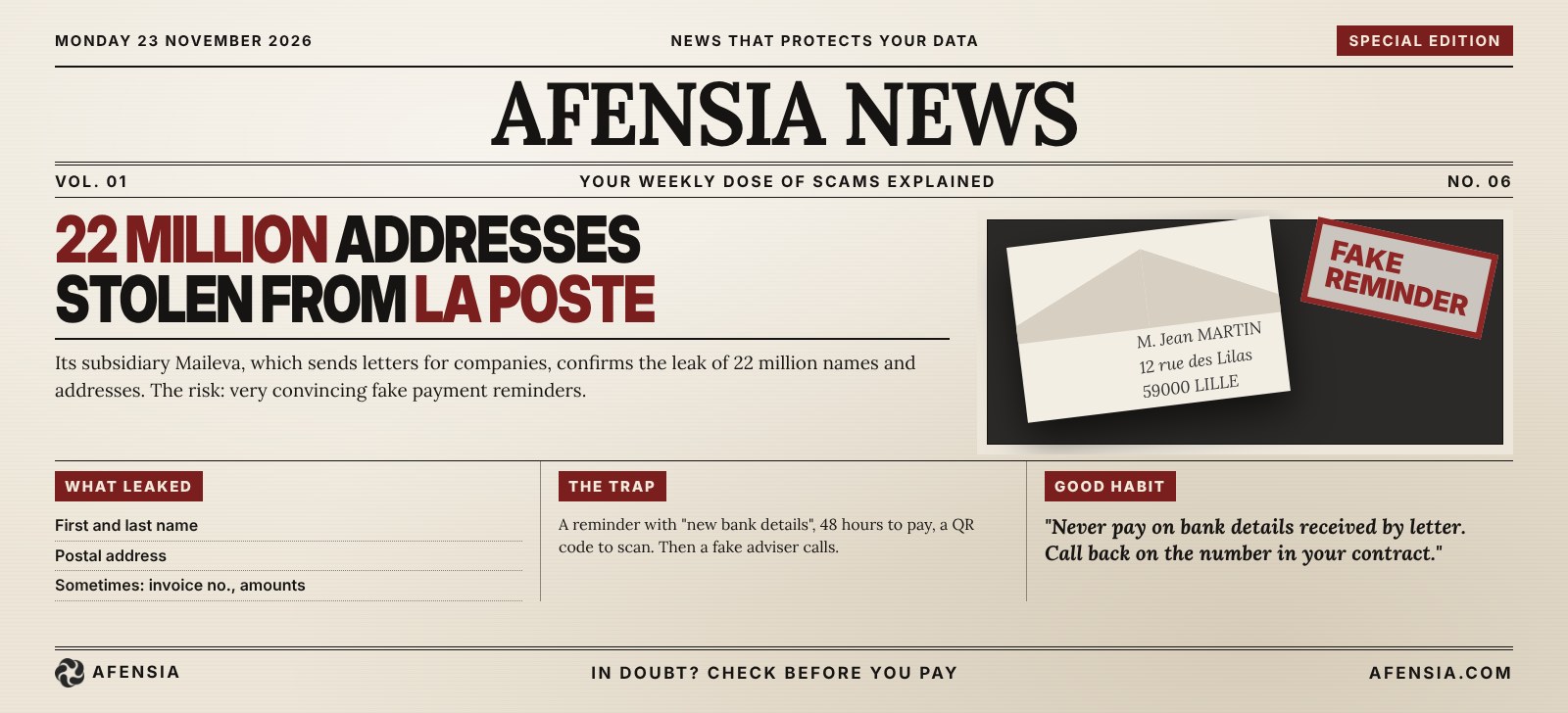
On 14 November, La Poste confirmed a massive data leak at Maileva, its subsidiary that sends letters on behalf of companies and organisations: invoices, payment reminders, registered letters, notices. The names and postal addresses of about 22 million people were exposed.
What happened
According to published reports, an attacker got into the platform from 9 September. Maileva shut its services from 23 to 29 September after spotting fraudulent access and mailings, then the investigation revealed the scale of the leak, confirmed in mid-November. The CNIL (the French data protection authority) was notified and a complaint was filed.
The victims are not Maileva's customers but the people the letters were sent to. If your landlord, a lab, a hospital or a supplier wrote to you through this service, you may be affected.
What leaked: first name, last name and postal address, and for some letters part of the content (invoice numbers, customer numbers, amounts due, care dates). According to La Poste, recipients' bank details are not affected. There is no public tool to check whether you are in the file: the organisations concerned must inform you.
What to expect
An address alone won't empty a bank account. But with your real name, your real address and sometimes a real invoice number, a scammer can build a very convincing scam. In the coming weeks, expect mainly:
- A fake payment reminder, by post or email, quoting a real invoice.
- "New bank details": "our bank has changed, please pay into this account".
- A QR code to pay printed on the letter.
- A link in a text or email: "pay your invoice", "verify your details", "your parcel is waiting".
- A call or voice message from a fake adviser who already knows your address.
What Afensia can do for you against these scams
For each of these situations, Afensia tells you in seconds whether it's a scam, before you pay:
- The reminder has a QR code? Scan it with Afensia. The app reads it without opening the site and tells you where it really leads.
- You got a link by text or email? Copy it without opening it and paste it into Afensia: fake site, site created a few days ago, imitation of a well-known company… the app tells you if it's dangerous, and why.
- The message arrived on WhatsApp or Telegram? Forward it to the Afensia contact: the answer arrives right in the conversation.
- An "adviser" left you a voice message? Send it to Afensia: the app detects voices that have been faked or created by AI.
- Want to know what's already out there about you? Check your email address: Afensia tells you whether it appears in other known leaks, and what leaked. Scammers often combine several files.
Your first checks are free, no account needed.
Good habits
- Never pay based on a letter announcing new bank details. Contact the organisation using the number on your contract or online account, never the one on the letter.
- Be wary of urgency: 48 hours, penalties, service cut-off. It's the most common sign.
- Never share a code received by text with someone who calls you, even if they know your name and address.
- Before a transfer, check the payee's name: your bank must warn you if it doesn't match the account holder.
- You can ask an organisation whether your data is affected: it must reply within one month.
Were you told your data leaked?
If an organisation wrote to tell you your data was part of the leak, be especially careful in the coming weeks and months: a stolen file can be reused long after.
Be wary above all of any message that uses your details to win your trust: your name, your address, a customer or invoice number. It isn't proof that the message is genuine: it's exactly what the scammers got hold of. If in doubt, check it with Afensia.
For fake parcel texts, see also our article on the fake parcel scam.
If you have already paid
Call your bank immediately to block or dispute the payment. Get help at 17cyber.gouv.fr, then file a police report: your bank may ask for it.
Sources
- Une filiale de La Poste victime d'un vol de données massif, 22 millions de personnes concernées — Maire info
- Maileva (La Poste) : fuite de données de 22 millions de personnes — IT-Connect
- Piratage de Maileva : que deviennent vos données ? — Selectra
- La Poste / Maileva : 22 millions de noms et adresses volés — JeChange
- 17Cyber, the French public service for cybercrime victims